
Park more cars in less space — without the ramps, the circling or the dented doors. IET Solutions supplies, installs and maintains automatic car parking systems across Kenya: fully automated structures that store and retrieve vehicles by machine, so a compact footprint holds far more cars than a conventional garage.
IET Provides Best Automatic Car Parking Systems
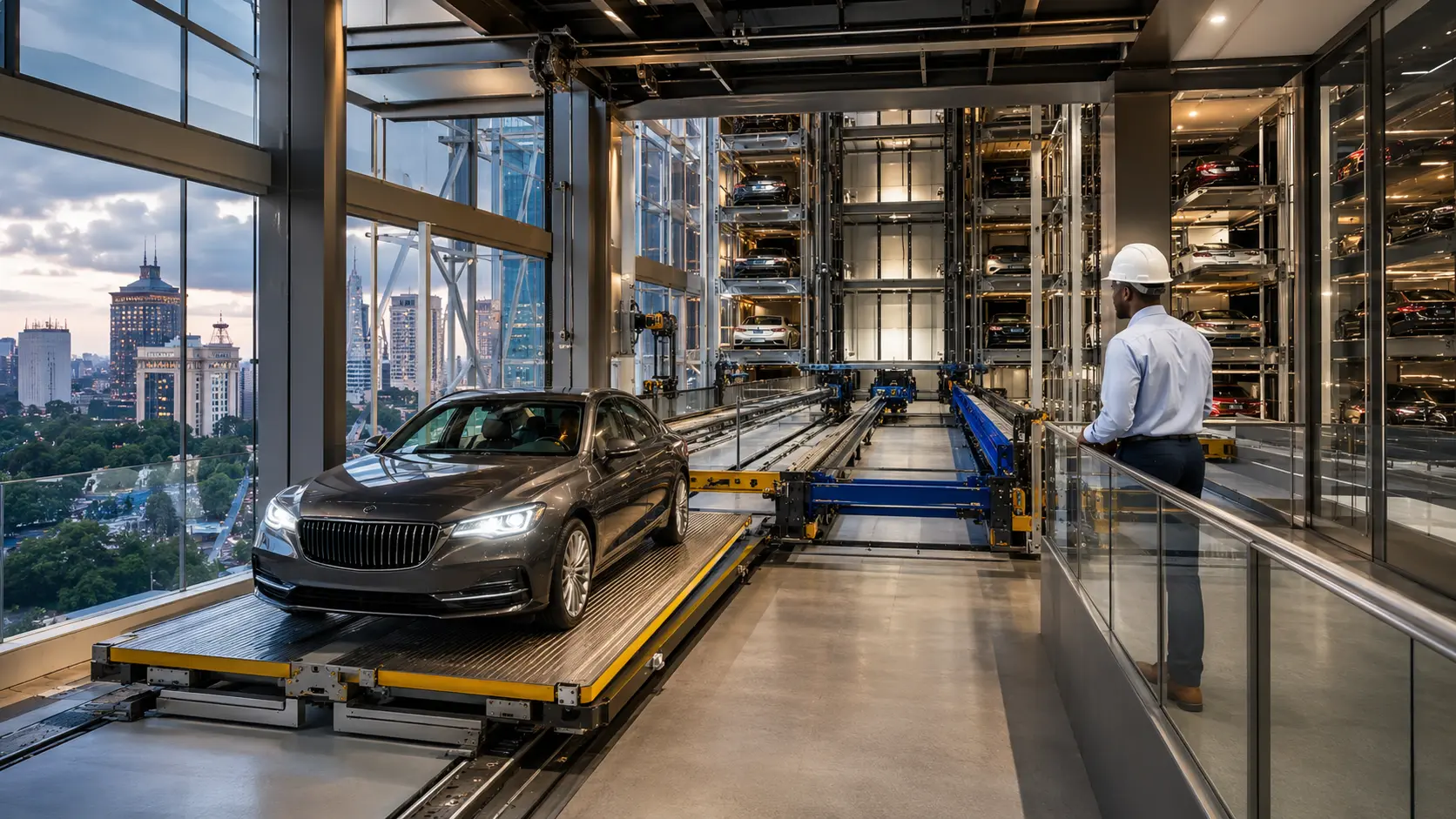
An automatic car parking system is a fully automated structure that parks and retrieves vehicles by machine — the driver stops in an entry bay, steps out, and robotics take over from there. Because nobody drives inside and no space is lost to ramps, aisles or open car doors, the same plot holds far more vehicles than a traditional garage. On many sites that means roughly 60–120% more capacity in the same footprint.
IET Solutions brings this technology to Kenya, working with specialist automated-parking manufacturers alongside our lift and escalator brands. We manage the whole project from Nairobi — feasibility and system selection, supply, installation, integration and long-term maintenance — so the parking structure is engineered around your site rather than forced onto it. Automated parking is not an off-the-shelf purchase; the plot, the car count and the traffic pattern decide the system, which is why the feasibility study comes first.
Safety and control are designed in, not added on: positioning sensors, access control, fire-safety provisions and emergency procedures come as standard, which makes an automated system safer than an open garage, where reversing and manoeuvring cause most incidents. Drivers request their car by ticket, code or mobile app and typically wait between 45 seconds and three minutes.
How It Works
Common System Types
Puzzle / Stacker Systems
Cars shuffle on independent platforms to reach any vehicle. Ideal for homes, villas and small commercial lots.
Tower Systems
A tall, small-footprint tower stacks vehicles vertically — strong for tight urban plots serving offices, malls and hotels.
AGV / Robotic Systems
Automated guided vehicles carry cars to their bays. Suited to premium buildings, airports, hospitals and large developments.
Pallet / Semi-Automated Stackers
A practical, lower-cost option for tenant or low-traffic corporate parking.
Key Features
More Cars, Same Plot — machine storage removes ramps and aisles, so a compact footprint parks roughly 60–120% more vehicles than a conventional garage.
Nobody Drives Inside — drivers leave the car at the entry bay and robotics do the parking, removing the scrapes and reversing accidents of open garages.
Retrieval in Minutes — cars are called back by ticket, code or app and returned front-first, typically within 45 seconds to three minutes.
Safety & Access Built In — positioning sensors, access control, fire-safety provisions and emergency procedures are designed into every system.
Sized to Your Site — from puzzle stackers for a villa to a tower system on a tight city plot, the configuration is matched to the space and the traffic.
Supplied & Serviced Locally — IET manages feasibility, installation, integration and maintenance from Nairobi, so the system has local support for its whole life.
Specifications
| System types | Puzzle / stacker · tower · AGV-robotic · pallet |
| Capacity | From a few cars to several hundred, by configuration |
| Added capacity | Roughly 60–120% more than a conventional garage (site-dependent) |
| Retrieval time | ~45 seconds – 3 minutes per vehicle |
| Access & control | Ticket, PIN code or mobile app; number-plate / RFID options |
| Vehicle handling | Automated lifts, shuttles and turntables |
| Safety | Positioning sensors, access control, fire-safety provisions, emergency stop and procedures |
| EV charging | Charging bays can be integrated into the system |
| Compliance | EN 14010 (safety of power-driven parking equipment) plus local building and fire codes |
| Power | Three-phase |
System type, capacity and dimensions are engineered per site and confirmed at feasibility/survey.
Where It Fits
How We Deliver
FAQs
What's the difference between automatic parking and a mechanical stacker?
A mechanical stacker simply lifts one car above another. An automatic car parking system goes further — it manages the full positioning, movement and storage of each vehicle with robotics and digital control, and no driver goes inside. Stackers suit small, low-traffic sites; automated systems suit higher densities and busier buildings.
Are automatic car parking systems safe?
Yes, and generally safer than a conventional garage. Access control, positioning sensors, fire-safety provisions and emergency procedures are built in, and because drivers and pedestrians never enter the parking area, the reversing and manoeuvring that cause most garage accidents are removed.
How many more cars can I fit?
It depends on the plot and the system, but automated parking typically adds in the region of 60–120% more capacity than a conventional garage of the same footprint, because ramps, aisles and door-swing clearances are no longer needed. We confirm the exact gain during the feasibility study.
Can it work with EV charging and my access or payment system?
Yes. Charging bays can be integrated for electric vehicles, and entry can run on tickets, PIN codes, number-plate recognition or a mobile app, tied into your access and payment setup.
How much does an automated parking system cost in Kenya?
Cost depends on the system type, the number of spaces, the site and the level of integration, so a single figure would only mislead. We give a firm quote after a feasibility study, and can weigh it against the land and floor area a conventional garage would otherwise need.
Ready to Park More in Less Space?
Let’s assess your site and find the automated parking system that fits it. Request a free quote or book a site assessment today.
Kenya Office
B67, 6th Floor, Valley View Office Park, City Park Drive, Parklands, Nairobi, Kenya
Tel: +254 725 000 052 · +254 116 003 009