
Compact, quiet home lifts for private residences, villas, maisonettes and apartments across Kenya — built to fit the house you already have, and to keep working when the power does not.
Install IET Residential Elevators; luxury & Comfort
A home lift has to fit a house that’s already built, or already designed — IET installs residential lifts across Kenya for villas, maisonettes, apartments and holiday homes, typically two to five floors.
Ours run in compact shafts with shallow pits and low headroom, and where there’s no shaft at all, a self-supporting structure goes into a stairwell void or against an external wall — the survey confirms what the house can give before we quote.
Every lift is built to EN 81-41 with battery lowering standard, so in a power cut the car descends to the nearest floor and opens its doors — the feature that matters most in most Kenyan homes.
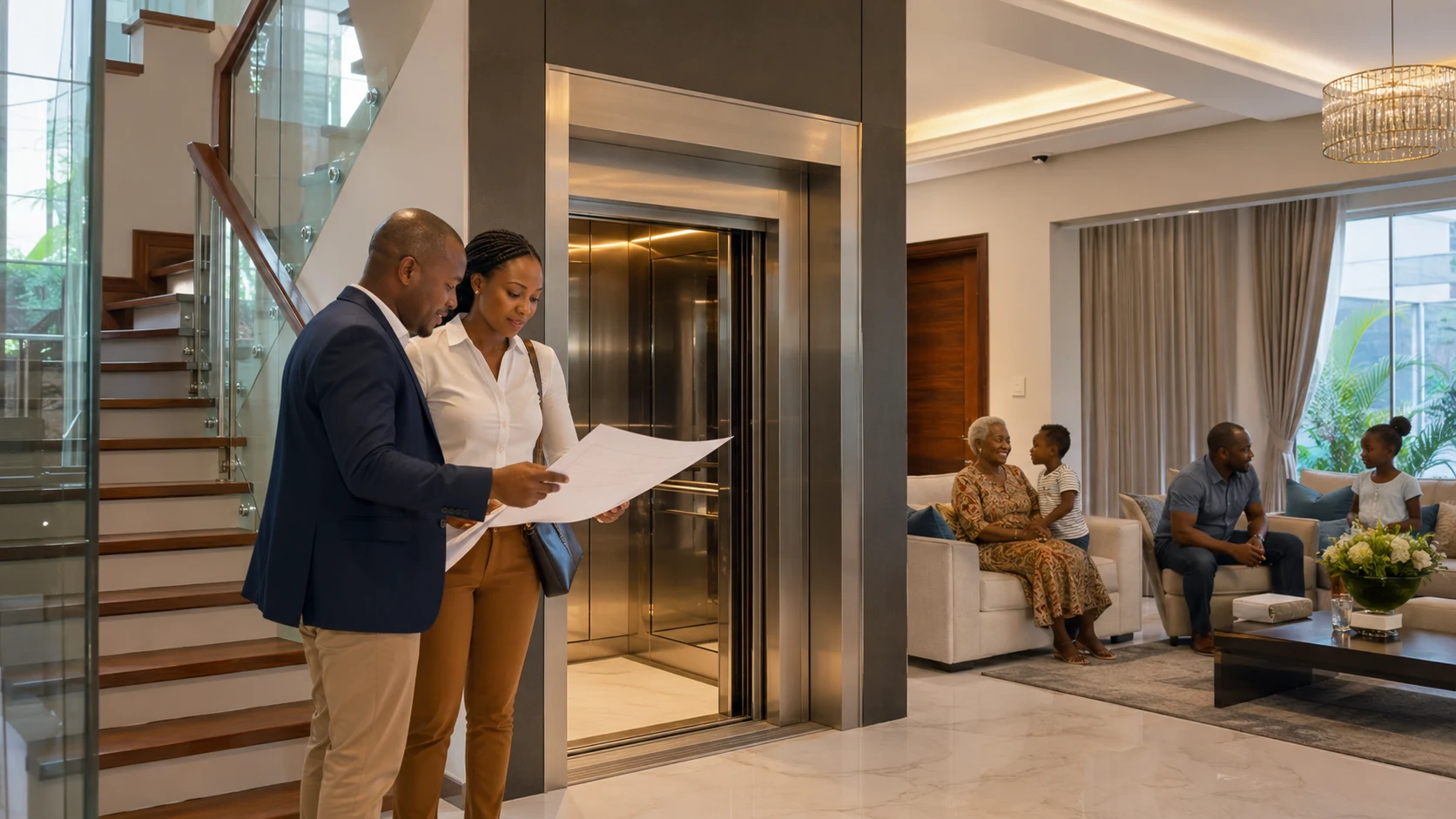
Key Features
Compact Footprint — fits tight shafts with a shallow pit and low headroom, so the house rarely has to be rebuilt around the lift.
Whisper-Quiet Drive — gearless and screw-drive systems run quietly enough to sit beside a bedroom wall.
Energy Efficient — standby mode and LED cabin lighting keep the running cost close to a household appliance.
Custom Finishes — glass, timber, laminate or stainless steel cabins, specified to match the interior rather than fight it.
Accessibility Ready — wheelchair-friendly cabin dimensions and low-effort controls, so every floor stays usable as the household ages.
Safety Certified — battery lowering, door sensors and an emergency phone as standard, built to EN 81-41.
Specifications
| Capacity | 250 – 400 kg / 2 – 5 persons |
| Speed | 0.15 – 1.0 m/s |
| Floors | Up to 6 stops |
| Drive type | Gearless traction / screw drive / hydraulic |
| Door type | Automatic sliding or manual swing |
| Cabin finish | Glass, timber, laminate or stainless steel |
| Controls | Collective |
| Safety | Battery auto-rescue (lowering), door sensors, emergency phone |
| Pit & headroom | Shallow-pit and low-headroom configurations available |
| Compliance | EN 81-41 (private residential lifts) |
| Power | Three-phase; single-phase option on most models |
Exact configuration depends on the house; confirmed at survey.
Where It Fits
How We Deliver
Related Projects
Caspian Apartment
Wavemark Properties
Nyali, Mombasa
17 Stops
Embassy Heights
Embassy Homes
South C, Nairobi
17 Stops
Pine Tree Residence
Maestro Homes
Parklands, Nairobi
20 Stops
FAQs
How much does a home lift cost in Kenya?
There is no single figure, and any company that gives you one before seeing the house is guessing. The price is driven by the number of floors, the drive type the structure allows, whether a shaft already exists or has to be built, the cabin finish, and the builders’ work needed to prepare the opening. We survey the house, then give you a firm price — and we will talk through the cost drivers early, so you can budget before you commit to anything.
Can a home lift be fitted into a house that is already built?
In most cases, yes. Compact shafts, shallow pits and low headroom requirements mean a lift can often go into an existing stairwell void, a redundant cupboard run, or against an external wall using a self-supporting structure. The survey confirms it. Retrofitting is more involved than building the shaft during construction, so if the house is still on the drawing board, tell your architect now.
How much space does it need?
Less than most people assume. A two-person home lift needs a footprint comparable to a generous cupboard, plus a shallow pit and modest headroom above the top floor. The exact figures depend on the model and the capacity you choose, which is why we measure before we specify.
What happens in a power cut?
The car lowers to the nearest floor and opens its doors. Battery lowering is standard on every home lift we install, so nobody is left waiting inside the car for the supply to return. Most models also run on a single-phase supply, so the lift does not require a three-phase connection to the house.
How long does installation take?
Most home-lift installations take one to three weeks on site once the shaft or hoistway is ready. The longer part of the schedule is usually the lead time for the lift itself, because units are built to order. We give you a firm schedule after the site survey, so you can plan the rest of the build around it.
Is a home lift safe for children and elderly users?
Yes. Home lifts are built to EN 81-41, the European standard for private residential lifts, with door sensors that stop the doors closing on anyone, an emergency phone inside the car, and controls that need no strength to operate. Cabins can be sized to take a wheelchair, which is often the reason a lift is fitted in the first place.
Thinking About a Lift for Your Home?
Let’s look at the house and tell you what will fit — and what it will cost. Get a free quote or talk to an engineer today.
Kenya Office
B67, 6th Floor, Valley View Office Park, City Park Drive, Parklands, Nairobi, Kenya
Tel: +254 725 000 052 · +254 116 003 009