
Escalators move a crowd without anyone waiting. IET supplies, installs and maintains commercial, heavy-duty and outdoor escalators across Kenya — sized to your passenger flow, built to EN 115, and serviced by a local team.
Types of Escalators We Supply
Commercial
Shopping malls, supermarkets, hotels and office lobbies. Steady daily traffic, standard duty.
Heavy-Duty / Transit
Airports, stations and stadiums. Reinforced for all-day crowds and higher rises.
Outdoor & Semi-Outdoor
Weather-protected drives and controls for open-air malls, terraces and footbridges.
Sizing an Escalator to Your Crowd
Capacity comes mainly from step width. At a standard 0.5 m/s:
These are theoretical maximums — we size against your actual peak, from a traffic study rather than a catalogue.
- 600 mm step — around 4,500 persons per hour
- 800 mm step — around 6,750 persons per hour
- 1,000 mm step — around 9,000 persons per hour
Key Features
Sized to Real Passenger Flow — step width and speed follow a traffic study, so the escalator absorbs the peak crowd.
Built to EN 115 — handrail speed monitoring, comb-plate switches, missing-step detection and emergency stops as standard.
Energy-Saving Auto Start/Stop — variable-speed drives slow or pause the unit when it is empty, cutting electricity through quiet hours.
Graceful in a Power Cut — the escalator stops in a controlled way and works as an ordinary staircase until power returns.
Hyundai-Backed Engineering — built on our regional Hyundai Elevator agency and international manufacturing standards.
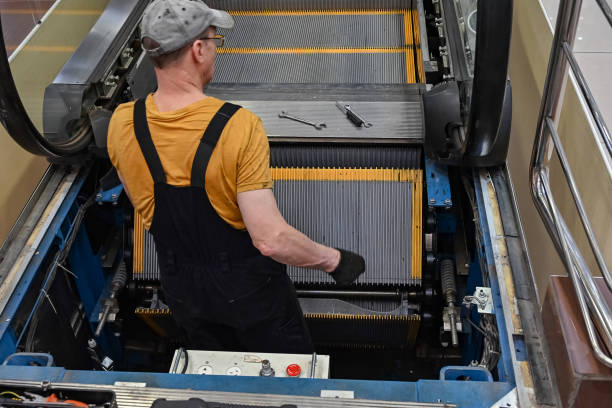
Serviced Locally — a Nairobi team keeps escalators running and can modernise ageing units without full replacement.
Specifications
| Inclination | 30° or 35° |
| Step width | 600 / 800 / 1,000 mm |
| Speed | 0.5 m/s standard; up to 0.65 m/s on transit-grade units |
| Rise | Up to ~10 m on commercial units; higher on transit units |
| Capacity | Up to ~9,000 persons/hour (theoretical, 1,000 mm step at 0.5 m/s) |
| Balustrade | Tempered glass or stainless steel |
| Drive | Chain-driven step band with VVVF inverter control |
| Safety | Handrail speed monitor, comb-plate switches, missing-step detection, skirt brushes, emergency stops |
| Compliance | EN 115-1 (new) · EN 115-2 (existing) |
| Power | Three-phase |
| Environment | Indoor / semi-outdoor / outdoor |
Exact figures depend on model and configuration; confirmed at survey.
Where It Fits
How We Deliver
Related Projects
FAQs
Should I choose an escalator or a lift?
They solve different problems, and most busy buildings need both. An escalator moves a continuous stream of people between a few floors — nobody waits. A lift serves wheelchair users, prams, trolleys and goods, and reaches every floor of a taller building.
How many people can an escalator carry?
It depends mainly on step width. At standard speed, a 1,000 mm step is rated at roughly 9,000 persons per hour, an 800 mm step around 6,750, and a 600 mm step around 4,500. Those are theoretical maximums, so we size against your actual peak.
What step width should I choose?
A 1,000 mm step lets one person stand while another walks past, which is what busy malls and transport hubs need. An 800 mm step suits steady commercial traffic, and a 600 mm step suits light use or tight spaces.
What does an escalator need from my building?
An escalator arrives as a complete truss spanning between floors, so the building must provide support points able to carry it, a shallow pit at the lower landing, clear height along the incline and a three-phase supply. The survey confirms what is there and what needs builders’ work.
What happens in a power cut?
The escalator comes to a controlled stop and works as a staircase until power returns — unlike a lift, nobody is left stranded.
Do you maintain and modernise existing escalators?
Yes. We service escalators under maintenance contracts, and modernise ageing units with new controllers, drives, handrails, steps or balustrades — bringing them up to current EN 115 standards instead of replacing them outright.
Ready to Get Started?
Let’s study your passenger flow and find the escalator that fits it. Request a quote or talk to an engineer today.
Kenya Office
B67, 6th Floor, Valley View Office Park, City Park Drive, Parklands, Nairobi, Kenya
Tel: +254 725 000 052 · +254 116 003 009