

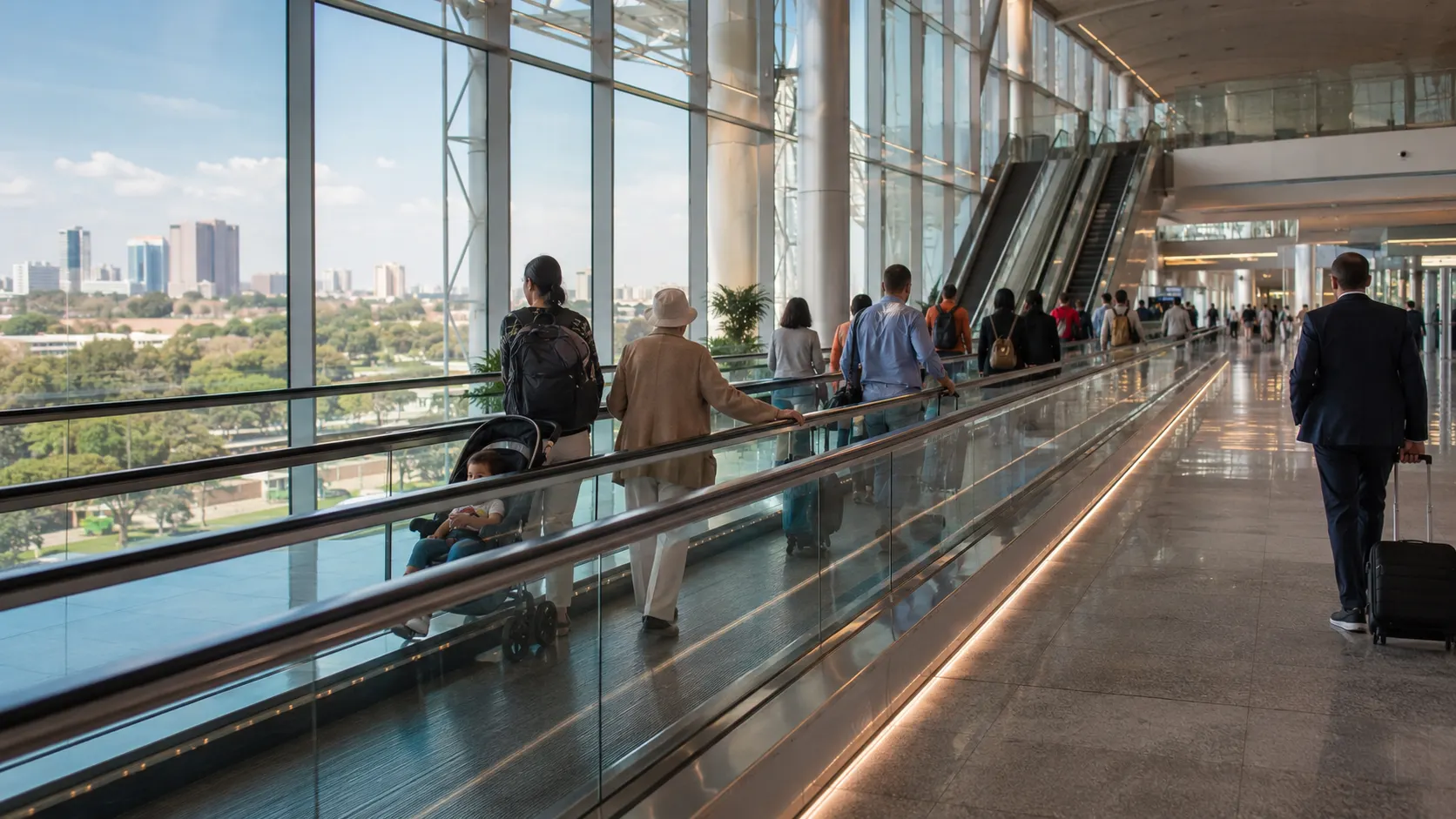

If you’ve ever dragged a suitcase through an airport or rushed across a large shopping mall, you’ve probably appreciated the relief that moving walkways provide. They cut long walks into easy, effortless motion; letting people move farther and faster with less fatigue.
Moving walkways aren’t all built the same way. Their design, purpose, and technology depend on where they’re installed and what passengers need.
What Are Moving Walkways?
A moving walkways system is essentially a moving surface, a conveyor platform that transports people horizontally or on a gentle slope. You can stand still or keep walking to move twice as fast. They support:
- Airports connecting terminals
- Metro stations and long public corridors
- Large commercial centers
- Exhibition venues and hospitals
Moving Walkways vs Escalators
People often associate moving walkways escalators together, but they serve different purposes:
- Escalators move people vertically (between floors)
- Moving walkways help cover long horizontal (or slightly inclined) distances
If you imagine an airport:
- Escalators take you up to your gate…
- Moving walkways take you there faster.
Both systems often work together to maintain smooth pedestrian flow.
Main Types of Moving Walkways
Let’s explore the most common variations you’ll find in public and commercial spaces.
Horizontal Moving Walkways
These are the classic travelators you see in airports.
Flat, straight, and designed for long-distance convenience.
They help people:
- Move faster without getting tired
- Handle long corridors and large halls with ease
- Transport luggage, strollers, and carts smoothly
In simple terms: they save time, energy, and frustration.
Inclined Moving Walkways
These look similar but include a gentle slope – perfect for multi-level spaces where stairs are not ideal.
Their benefits include:
- Smooth movement between different elevations
- Perfect for passengers with trolleys or carts
- Comfortable and less intimidating for elderly users
Malls and metro stations love these because people don’t need to lift anything — everything rolls.
Belt-Type vs Pallet-Type Moving Walkways
Moving walkways are built differently depending on the experience and durability needed.
Belt-Type
- Surface made from a smooth rubber or PVC belt
- Quiet operation
- Soft and comfortable underfoot
- Mostly installed in commercial areas or luxury retail spaces
It is all about comfort and aesthetics.
Pallet-Type
- Surface made of interlocking metal plates
- Very strong and reliable
- Designed for heavy daily usage and luggage weight
- Ideal for airports and major transit hubs
This type is chosen when durability matters most and traffic never stops.
Advanced and Modern Types of Walkways
Modern architecture demands more flexibility, and technology keeps up.
High-Speed Moving Walkways
These are next-level travel systems where the walkway gradually speeds up as you move forward. Think of them as the express lanes of pedestrian traffic.
Why they matter:
- Reduce travel time in huge buildings
- Support fast passenger flow
- Helpful for tight airport connection times
They require high safety standards and motion-control engineering, but offer an amazing user experience.
Curved or Flexible-Direction Walkways
Space isn’t always linear. Some buildings have unique layouts, corners, or circular paths. Curved moving walkways solve that by adapting to the shape of the architecture.
Their advantages:
- Fit where straight walkways cannot
- Support creative and efficient space use
- Allow smoother navigation in complex buildings
They showcase how mobility and design can work beautifully together.
Why Moving Walkways Matter in Today’s Buildings?
Investing in moving walkways benefits both the visitors and the building owner:
- Faster movement = fewer delays and crowds
- More inclusive design for elderly and disabled passengers
- Greater comfort for travelers and shoppers
- Better building flow and navigation
- A premium, modern experience that improves satisfaction
In high-traffic environments like airports and metro stations, moving walkways are no longer an extra luxury, they’re a necessity for operational efficiency.
How IET Solutions Can Help?
If you’re planning to install moving walkways or moving walkways escalators systems in Kenya, you need a specialist who understands both engineering and human experience.
That’s why IET Solutions supports their clients from the first planning sketch to long-term maintenance.
What IET Solutions provides:
- Expert feasibility evaluation and custom recommendations
- Supply of high-quality walkway systems with global standards
- Professional installation with safety-first engineering
- Reliable maintenance and service for long-term durability
Whether it’s for airports, shopping malls, transport hubs, or commercial projects, IET Solutions ensures that your investment delivers smooth mobility for years to come.
Final Thoughts
Not all moving walkways are built the same, so choosing the right type depends on factors like traffic volume, distance and layout, whether people will be using trolleys or strollers, the level of comfort versus durability required, and the available space within the architectural design.
The right walkway can completely transform how people feel while moving through your space; making the experience smoother, easier, and more enjoyable instead of tiring and overwhelming.
With guidance from experienced professionals like IET Solutions, you can select the ideal walkway system and create a better, more efficient journey for everyone who enters your building.
Talk to the experts and request a free consultation today at IET Solutions.
FAQs:
What are moving walkways called in airports?
They’re often called travelators or moving sidewalks — all meaning the same type of conveyor walkway.
Are moving walkways the same as escalators?
No. Moving walkways move people horizontally, while escalators move people vertically between floors.
Which walkway type is more common in airports?
Pallet-type walkways are widely used in airports because they handle heavy luggage and continuous foot traffic.
How do I decide between walkways and escalators?
Choose walkways for long spaces and rolling movement. Choose escalators for level changes.
Sources:
- Escalators/Moving Walks– HYUNDAIELEVATOR
- Moving walkway– Wikipedia
- Escalator vs Moving Walkway: What’s The Differences?– DAZEN Elevator.
- Types of Moving Walkways– FUJIXD
- Escalator vs. Moving Walkway: What’s The Differences– SCHMIDT Elevator
- Moving Walkways – Horizontal & Inclined Solutions– SCHMIDT Elevator
- Moving Walkways, Autowalks– DAZEN Elevator
- Elevators, Escalators, and Moving Walkways Information– GlobalSpec
- Could Your Building Benefit from Moving Walkways?– TKElevator
- Airport Moving Walkway: Enhancing Passenger Experience– Hosting Elevator
