


Choosing the right elevator for your building can feel overwhelming with so many options available. The two main contenders you’ll encounter are the hydraulic elevator and the electric elevator—each with its own strengths. So which one actually works better for your property? This practical guide breaks down the key differences in plain language, helping you make a confident choice.
What is an Electric Elevator and How Does It Work?
An Electric Traction Elevator relies on an electric motor to move the cabin between floors using steel ropes or flat belts. These ropes connect the cabin to a counterweight that moves in the opposite direction, which makes lifting easier and saves energy. The motor is usually installed inside a specially prepared shaft.
This is the most common elevator system worldwide, preferred for mid-rise and high-rise buildings because of its speed and efficiency.
What is a Hydraulic Elevator and How Does It Work?
A Hydraulic Elevator uses pressurized oil to move the cabin instead of the ropes and counterweight system. Let’s break down how it works in simple terms:
- Going Up: An electric motor kicks in to power a pump, which pushes oil from a storage tank into a cylinder. Inside that cylinder, a piston gets pushed upward by the oil pressure, gently lifting the elevator cabin to your chosen floor.
- Going Down: A valve opens up, allowing the oil to flow from the cylinder back into the tank. Gravity then takes over, bringing the cabin down smoothly without the motor having to do any work.
This system works best for low-rise buildings up to 5-6 floors. One big advantage? You don’t need a machine room at the top, which gives you more design freedom when planning your building.
Hydraulic elevators also have a safety advantage when it comes to power outages. If the electricity goes off, the cabin doesn’t get stuck; it simply relies on gravity. Here’s what happens: a valve opens, allowing oil to flow back into the tank, and the cabin gently lowers itself to the nearest floor without needing any power.
In modern hydraulic elevators, an intelligent safety valve manages this automatically. It opens gradually, so the descent is slow, controlled, and completely safe. Once the cabin reaches the closest floor, the doors open normally. No stress, no worry, just a smooth return to solid ground.
Which is More Cost-Effective: Hydraulic Elevator or Electric One?
When comparing costs between hydraulic and electric elevators, four main factors matter: the initial installation cost, long‑term operational costs, the complexity and cost of excavation, and maintenance contracts.
- Initial Installation Cost: Hydraulic vs. Electric
Hydraulic elevators generally cost less to install than traditional electric models. The excavation work is also less complicated, particularly for buildings with only one or two floors.
- Long-Term Operational and Energy Consumption Costs
When discussing post-installation operational costs and energy consumption, electric elevators are more cost‑effective in high-traffic commercial buildings, where traction elevators can cut energy use by 20–40% compared to hydraulic systems, especially in commercial buildings with high traffic and buildings higher than 5 floors.
The counterweight system of an electric elevator balances the cabin’s weight, which makes it easier for the motor to lift the elevator’s cabin. This results in noticeably lower energy consumption, especially in buildings with three or four floors. For shorter buildings, the difference may be smaller.
Hydraulic elevators consume more electricity because the motor works harder to raise the cabin, particularly when carrying heavier loads.
- Installation and Excavation Procedures: Hydraulic vs. Electric
- Excavation for electric elevators is relatively complex, even with modern Machine‑Room‑Less (MRL) designs. These systems often require precise pit dimensions and specific safety provisions to protect maintenance workers. However, the pit depth for an electric elevator is fixed, it does not change with the travel height.
- For traditional hydraulic elevators, excavation is technically simpler because the pit is only needed for the piston, not for a motor or counterweight. However, the pit must be as deep as the elevator’s travel distance. For example, a hydraulic elevator serving four floors requires a shallow pit (about 1.2–1.8 meters), but the cylinder extends far below it—often as deep as the total travel distance plus an additional 1.2–2.1 meters, meaning a total cylinder depth of approximately 16 meters for a typical four-floor installation.
- Excavation for electric elevators is relatively complex, even with modern Machine‑Room‑Less (MRL) designs. These systems often require precise pit dimensions and specific safety provisions to protect maintenance workers. However, the pit depth for an electric elevator is fixed, it does not change with the travel height.
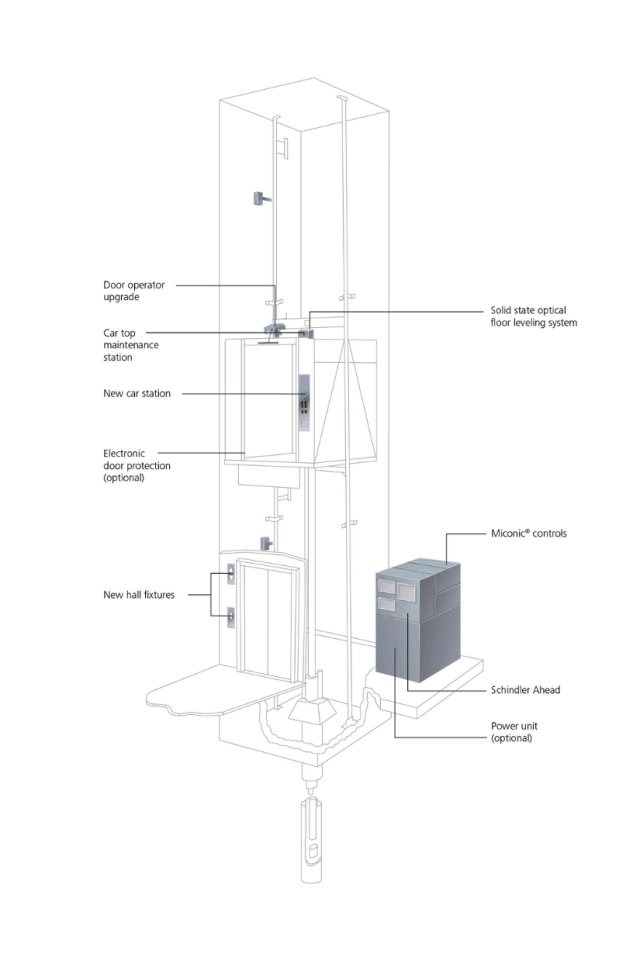
Hydraulic Elevator Diagram, via Schinder
- When Would a Hydraulic Excavation Become Complex? If the ground is rocky or the water table is high, digging a deep pit (more than 5 meters) can become expensive and technically challenging, even though the hydraulic system itself remains simple.
- When Would a Hydraulic Excavation Become Simplest? With holeless hydraulic elevators, the piston is placed beside or behind the cabin instead of under it. This design eliminates the need for a deep pit, making excavation the simplest of all elevator types.
- Cost of Periodic Inspection and Maintenance Contracts
- Electric: Requires specialized periodic maintenance for the motor and cables, but it is typically less frequent.
- Hydraulic: Maintenance is simpler, but it requires regular monitoring of oil levels and inspection of hoses to prevent leaks.
Which is Faster: Hydraulic or Electric Elevator?
Electric elevators are noticeably faster than hydraulic ones. A modern electric elevator can travel at speeds of up to 4 meters per second, whereas a hydraulic elevator typically moves at about 1 meter per second or less.
For this reason, electric elevators are the preferred choice for high‑rise buildings and skyscrapers where speed and efficiency are essential. Hydraulic elevators, on the other hand, are well suited for homes, resorts, and commercial buildings with up to five or six floors, where their slower speed is not a limitation.
Final Tip
Before making a decision, consult with qualified specialists. Request an on‑site assessment of your property, compare proposals from different providers, and pay close attention to warranties and after‑sales support. A well‑chosen elevator is an investment that delivers comfort and safety for years to come.
For a competitive quote backed by quality assurance and dependable after‑sales service, reach out to the IET Solutions team. We are here to assist.
Frequently Asked Questions About Hydraulic and Electric Elevators
1. Is a hydraulic elevator safe during a power outage?
Yes. Hydraulic elevators are designed with safety in mind. When power fails, an automatic safety valve opens, allowing the cabin to descend slowly using gravity to the nearest floor, where the door automatically opens.
2. Which elevator is more economical in the long run, electric or hydraulic?
Electric elevators generally cost less to operate over time because they use less energy and require less frequent maintenance. Hydraulic elevators have a lower upfront installation cost but consume more energy and need more regular checks.
3. What is the most common problem with hydraulic elevators?
Oil leaks from the cylinder or hoses. However, regular inspections help maintain efficiency and prevent leaks that could affect performance or the environment.
Sources: