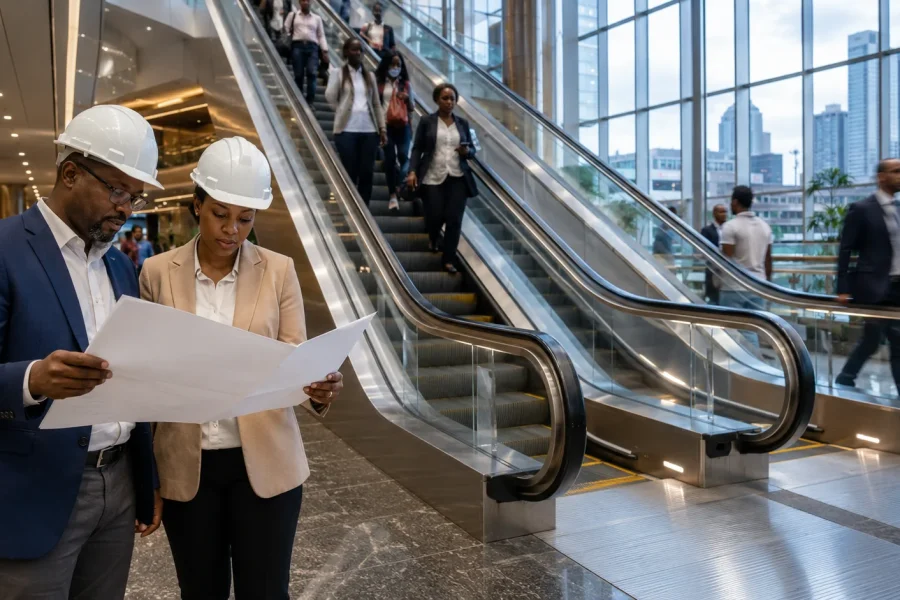

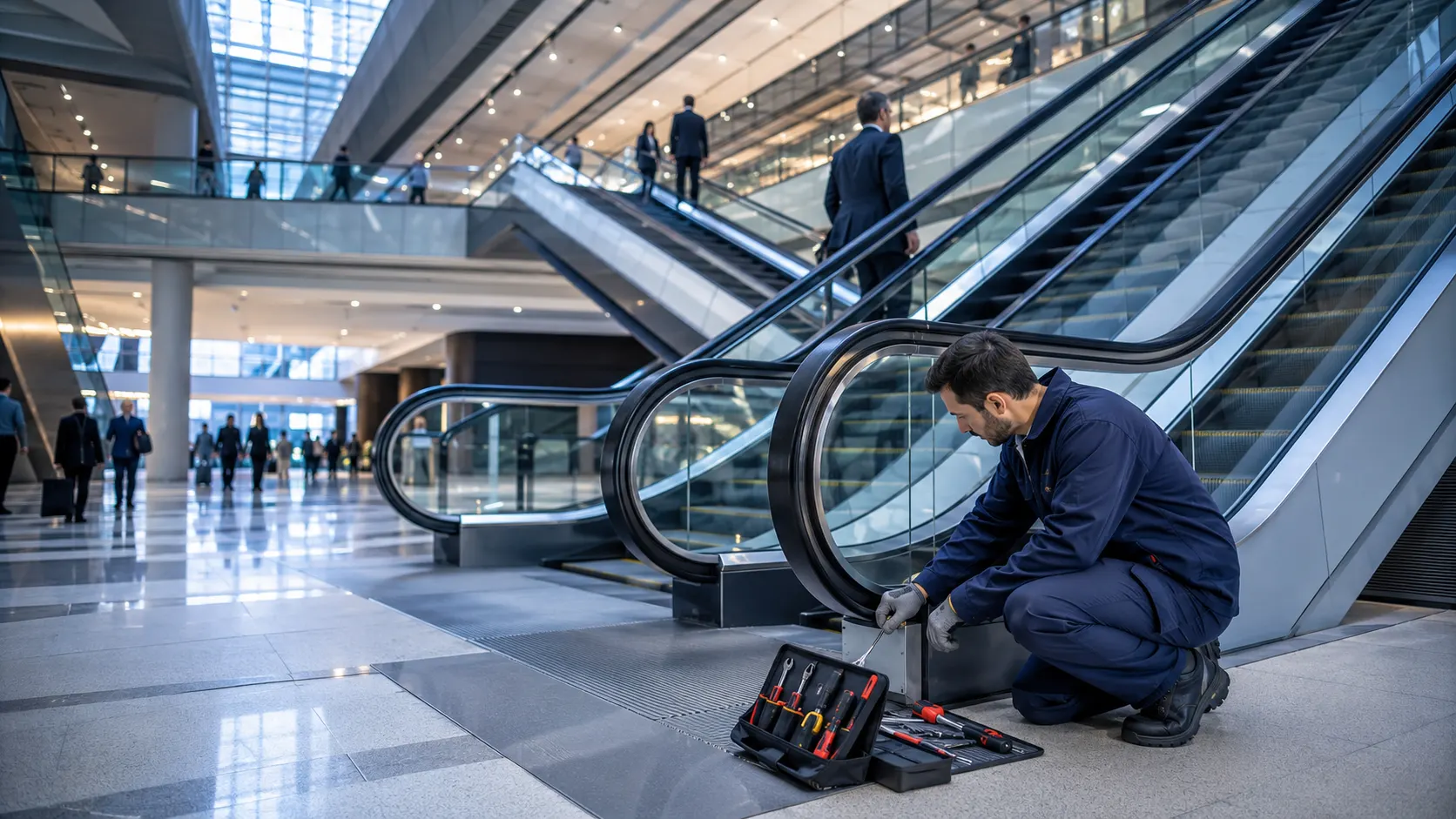

Escalators are essential mobility systems in Kenya’s growing commercial and public buildings. They allow people to move quickly and smoothly between floors, especially in places with high foot traffic like malls, airports, and transport stations. As Nairobi, Mombasa, and other cities continue expanding upward, demand for escalators is rising; driven by convenience, safety, and accessibility needs.
What Is an Escalator?
An escalator is a powered moving staircase that runs on a continuous loop. People step onto it and are transported smoothly between different levels of a building. Unlike elevators, which move in a cabin, escalators support a continuous flow of passengers, making them perfect for busy public environments.
Escalators feature mechanical steps that maintain a flat surface when stepped on, forming a staircase over the slope but leveling again at landings for safe entry and exit. This design enables seamless movement while reducing the risk of tripping.
How Escalators Differ from Stairs and Elevators?
Escalators bridge a functional gap between static stairs and enclosed elevators:
- Compared to stairs, escalators eliminate physical effort and speed up vertical movement.
- Compared to elevators, they support continuous high-volume transport instead of one batch at a time.
They are not a replacement for elevators, particularly for those using wheelchairs, but they complement accessibility planning and improve circulation in crowded areas.
How Do Escalators Work?
Escalators rely on a highly engineered mechanical system designed for many years of heavy operation. The key technology involves a motor-driven rotating chain that moves the steps along a guided track. This track controls the geometry of each step, keeping it level and safe for standing passengers.
Key Components of Escalators
Here’s how each core element contributes to safe operation:
- Drive Motor: provides power to the entire system, ensuring smooth step movement.
- Step Chain: connects each step and moves them in a synchronized, continuous loop.
- Guiding Track: ensures the steps remain flat where passengers stand and tilt only underneath the landing areas.
- Handrails: run at the same speed as the steps to support passenger balance.
- Truss Structure: provides strength, supporting the escalator between building floors.
- Comb Plates: ensure a safe transition between the stationary floor and moving steps.
- Safety Sensors & Control System: monitor speed, alignment, and emergencies.
- Skirt Panels and Brushes: minimize the risk of clothing or footwear getting trapped.
The machine room, typically located at one end of the installation, houses the control panel and part of the drive system, enabling technicians to inspect and maintain performance.
Safety Systems and Passenger Protection
Escalators are built with multiple layers of safety:
- Emergency stop buttons at top and bottom landings
- Anti-rollback brakes in case of sudden power loss
- Overspeed monitoring to detect mechanical issues early
- Step gap safety to prevent entrapment
- Fire safety materials and approved construction standards
Kenya’s building codes increasingly align with global standards such as EN 115, ensuring escalators installed in the country follow strict international safety requirements.
Maintenance & Reliability
Escalators operate for thousands of hours every year and require:
- Regular cleaning of internal parts
- Lubrication of chains and bearings
- Replacement of worn steps, rollers, or sensors
- Calibration of speed and handrail tension
- Safety compliance checks
Working with experienced escalators companies ensures dependable, long-term performance and minimizes operational downtime.
If poorly maintained, escalators may become noisy, require repair frequently, or present safety risks, which is why choosing the right partner is crucial.
Why Use Escalators?
Escalators offer benefits that are particularly helpful in Kenya’s busiest zones:
- High Passenger Throughput: Move thousands of people per hour efficiently in high-traffic spaces.
- Minimal Waiting Time: Continuous movement allows users to step on and go without queues.
- Efficient Space Utilization: One escalator can match the capacity of several elevators while maintaining good design.
- Energy-Efficient Technologies: Motion sensors, regenerative drives, and standby modes reduce power consumption.
- Encourages Customer Flow: In malls, escalators increase visibility and circulation across all floors.
- Supports Accessibility: Reduces physical strain and improves convenience in multi-floor environments (elevators still required for wheelchairs).
Different Types of Escalators
Selecting the right escalator depends on the design of the building, expected passenger density, and environmental conditions. Each type serves a unique purpose:
Parallel Escalators.
These are installed side-by-side, one going up and the other going down, the most common and easiest to navigate.
They promote smooth bidirectional flow in shopping centers and airports.
Crisscross or Interlaced Escalators
Also called “zig-zag escalators,” these are stacked alternately as they go up each floor. Users walk across landings to switch sides.
They save space and keep customers circulating past more retail areas.
Spiral Escalators
These follow a curved path and are used in buildings that want a high-end visual centerpiece. They require specialized engineering and are less common in Kenya, but suitable for luxury environments.
High-Rise / Long-Travel Escalators
Used in deep stations, stadiums, or major transport infrastructure. They are ideal for future metro systems planned in Nairobi and other urban expansions.
Outdoor Escalators
Engineered for harsh weather, including:
- Rain exposure
- Temperature changes
- Dirt and moisture
- UV-resistant materials
They are commonly used in outdoor shopping zones or public facilities where circulating crowds move between open levels.
By selecting the right category from the start, developers avoid expensive redesigns or operational challenges later.
Choosing Escalators Companies in Kenya
Selecting the best partner for escalator installation and maintenance determines long-term safety, reliability, and efficiency.
What Makes a Good Escalator Provider?
Experienced escalators companies offer:
- Technical expertise in mechanical & electrical engineering
- Qualified installation teams with project experience
- Safety compliance and certification credentials
- Local service capability with rapid problem response
- Warranty and strong after-sales service
- High-quality global escalator brand partnerships
- Transparent processes and customer training
Before approving a project, always request performance records and inspection data to confirm quality standards.
Local Expertise Is Essential
While escalators may be manufactured abroad, maintenance must be managed locally to ensure reliability. Kenyan environments with dust, heat, or high humidity require proper configuration and regular servicing.
Partnering with a company based in Kenya ensures quick repairs and proper spare parts availability.
Final Thoughts
Escalators improve accessibility, safety, and passenger flow in busy buildings, making them essential to modern infrastructure. To secure long-term performance and compliance, working with expert escalators companies is critical.
Choose IET Solutions Kenya for trusted escalator supply, installation, and maintenance.
Visit IET Solutions — Smart mobility starts with the right partner.
FAQs:
Is an escalator called an elevator?
No. An elevator moves inside a vertical shaft, while an escalator is a moving staircase designed for continuous crowd transport.
What are the different types of escalators?
Parallel, crisscross, spiral, high-rise, and outdoor escalators — each built for specific architectural and traffic needs.
What is another name for escalators?
They are also commonly known as moving stairs or moving staircases.
Sources:
- Escalators/Moving Walks– HYUNDAIELEVATOR
- Escalator– Wikipedia
- Difference Between Elevators and Escalators for Modern Infrastructure– Fujitec
- Reliability and safety of elevators and escalators/ travelators: Past, present and future– Science Direct
- How Escalators Improve People Flow & Safety in Public Spaces– KONE
- Elevating Experiences: The Role of Escalators in Public Spaces- Illumin
- Escalators and its Usages– Apex Elevator