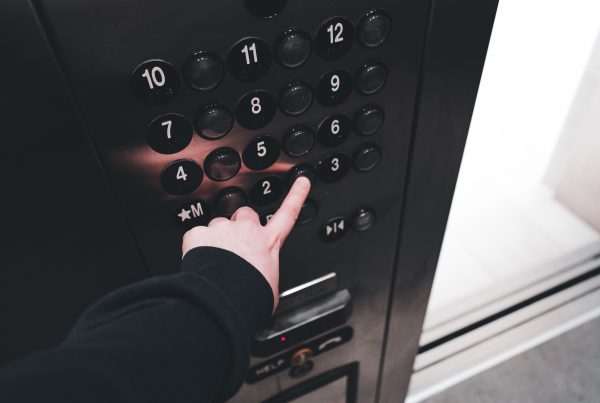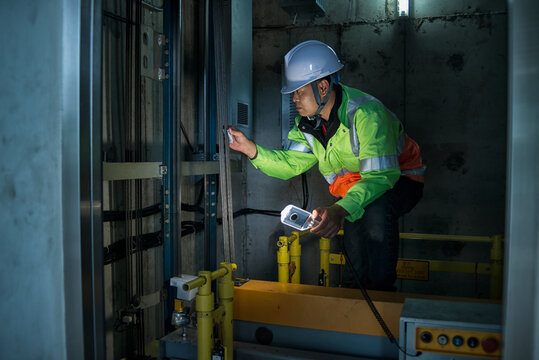

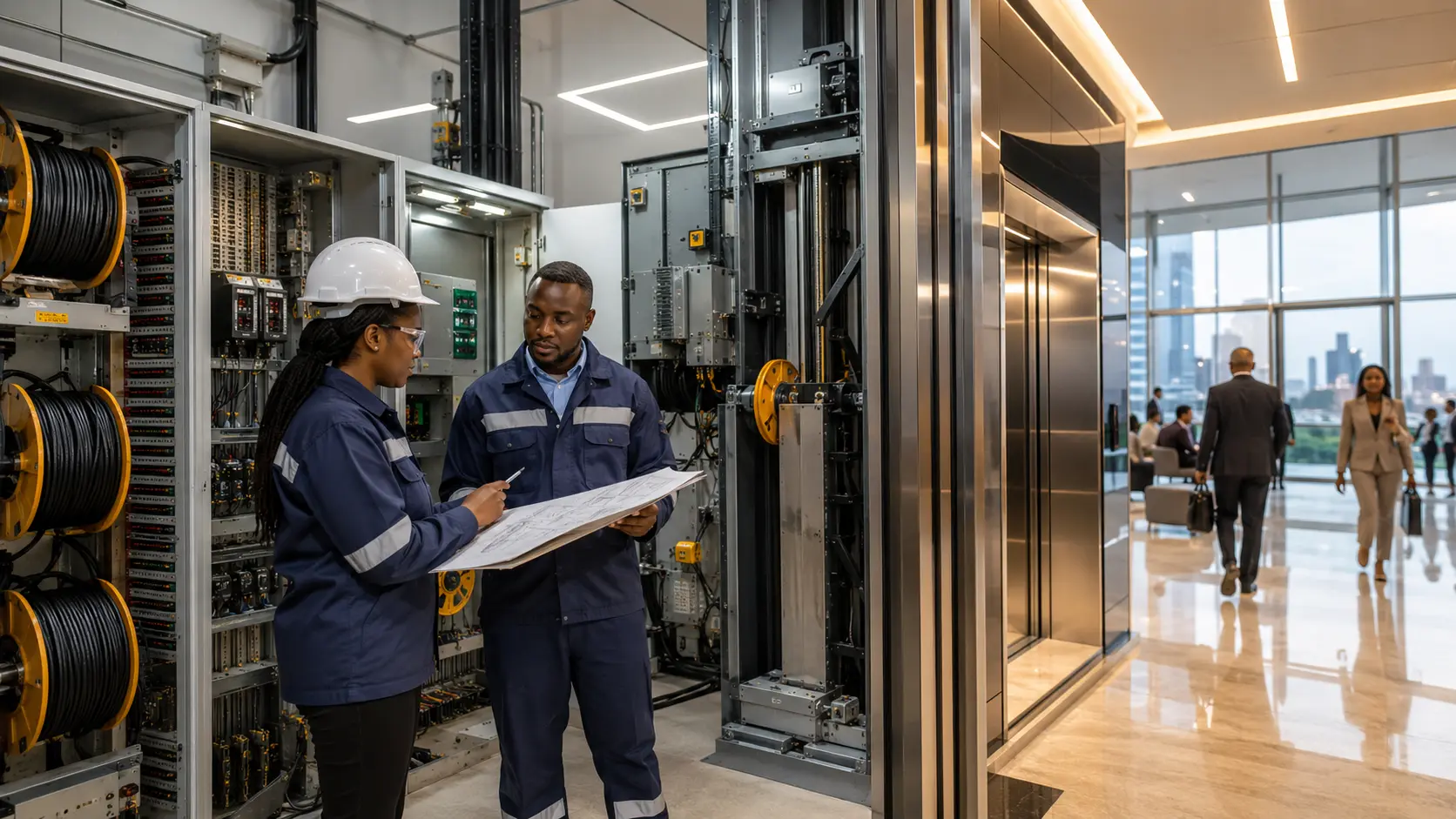

Walk past any tower going up in Westlands or Upper Hill and you’ll see what electrical engineering in Kenya looks like up close. The civil crew has finished the shaft. The steel is in. Then a smaller team shows up with cable reels, drive cabinets, and a control panel, and within a few weeks the building can move people. That’s the moment electrical engineering becomes the reason a 20-storey office works — and it’s the corner of electrical engineering in Kenya almost no one writes about. Most of the conversation focuses on the grid: generation, KPLC, the country’s push toward universal access by 2030. But vertical transportation has quietly become one of the discipline’s fastest-growing applications, and one of its most demanding.
Where does electrical engineering actually show up in Kenya today?
The grid story dominates: 3,840.8 MW of installed capacity by June 2025 (per EPRA), peak demand of 2,362 MW set in July 2025, a 5,000 MW target by 2030. Rightly so. It’s how the country gets to universal electricity access.
But electrical engineering in Kenya extends well past power generation. The same discipline sits inside the country’s industrial automation systems, data centres, mobile network base stations, hospital MRI rooms, and factory production lines. And in vertical transportation: every commercial elevator in Westlands, every escalator at an Upper Hill hotel, every service lift in a Mombasa Road warehouse runs on a stack of electrical engineering most people in the building never think about.
Why an elevator is one of the most electrically demanding machines in any building?
A modern traction lift in a 15-storey Nairobi office building integrates four electrical engineering disciplines working in real time, with passengers inside.
- Three-phase power: Lifts run on a 415V/50Hz dedicated feeder, sized for inrush current that can hit four to six times the running current at startup. Modern VVVF drives are sensitive to voltage sags and harmonic distortion, both common on Nairobi’s grid during peak hours. Good installations include cable sizing for inrush, dedicated earthing, surge protection, and often a line reactor ahead of the drive.
- Motor drives: The motor is usually an AC induction motor or a permanent magnet synchronous motor (PMSM), controlled by a Variable Voltage Variable Frequency (VVVF) drive. Closed-loop vector control reads the motor’s actual speed via an encoder and corrects the drive output thousands of times per second. That’s how a modern lift achieves positioning accuracy within a few millimetres at floor level. Regenerative drives can also feed energy back to the building during downward travel, cutting power consumption by 20 to 35 per cent.
- Control systems: A microprocessor-based controller registers calls, dispatches the car, manages doors, tracks position, talks to the building management system, and runs the safety logic. In multi-elevator buildings it does group control or, on newer installations, destination dispatch, which groups passengers heading to similar floors into the same car.
- Safety circuits: Built around one principle: any single fault must default to a safe state. Electromagnetic brakes are spring-applied and electrically released, so they engage automatically if power or the controller fails. The overspeed governor engages safety gear if the car exceeds about 115 per cent of rated speed. Door interlocks prevent the car from leaving a floor with any door open. Final limit switches catch the car if it travels past its normal range.
What’s different about elevator electrical engineering in Kenya
The underlying physics is the same anywhere. The local conditions are not.
Power quality is the recurring problem: KPLC’s Nairobi grid delivers acceptable supply most of the time, but voltage dips and harmonic distortion during peak demand are common enough that VVVF drives in commercial buildings need over-sized line reactors and dedicated earthing. In coastal Mombasa, humidity and salt-laden air work on control board contacts. In Eldoret and Nakuru, lightning surges during the long rains take out unprotected drives every season.
Standards are catching up: The Kenyan elevator safety standard is KS 2169, based on the European EN 81 family (EN 81-20 and EN 81-50 for traction and hydraulic lifts). At the inaugural iSEE Elevators and Escalators Expo in Nairobi in December 2025, KEBS announced new safety and performance standards. The Occupational Safety and Health Act 2007 also requires twice-yearly inspections of passenger lifts by a government-approved inspector.
The bigger gap is skills supply: The Engineers Board of Kenya reports about 28,000 registered engineers across all disciplines as of late 2025. Very few specialize in vertical transportation. Most lift-specific expertise sits inside OEM-trained service teams and a small number of independent specialists. And even where the technical knowledge is present, engine room resource management remains informal in most Kenyan commercial buildings. The day-to-day organisation of the machine room’s spares, documentation, and technician access is still ad-hoc, which shows up in slower fault resolution and longer downtime.
How can a building owner tell good electrical engineering from bad?
Without opening the cabinet, you can’t verify it directly. But seven questions tell you most of what you need to know:
- Drive type and brand. Modern installations use VVVF closed-loop drives from established OEMs such as Hyundai Elevator and FUJI. An unrecognizable brand is a problem.
- Earthing. Dedicated earth electrode for the machine room, separate from the building’s general earth.
- Surge protection. Type 1 SPD at the incoming supply, Type 2 at the drive cabinet.
- Cable sizing. Documented calculation accounting for inrush current, not just running current.
- Power conditioning. Line reactor or active filter in the drive cabinet, especially on multi-drive buildings.
- Emergency rescue operation. UPS sized for car lighting, alarm, intercom, and rescue-mode floor levelling.
- Inspection logbook. Twice-yearly entries per the OSH Act 2007. Gaps mean the lift hasn’t been inspected, and almost certainly hasn’t been maintained.
Three red flags that usually mean trouble within two years:
- No commissioning report, sizing calculations, or inspection certificates on file.
- Drive trips during KPLC peak hours (typically 6–9 pm). Usually undersized or absent power conditioning.
- White-label controller and drive. Cheap to buy, expensive to maintain, impossible to source spares for.
Machine Room Elevator vs. Machine Room-Less
For most of the past four decades, every commercial lift in Kenya was a machine room elevator, the motor, controller, and brake assembly housed in a dedicated room above the shaft. That standard is changing fast in Nairobi’s newer high-rises.
A machine room-less elevator (MRL) eliminates that dedicated room entirely by mounting the gearless motor, controller, and brake inside the shaft itself, typically at the top. The result: no rooftop machine room, reduced structural load, and lower building cost, without sacrificing performance.
The trade-off is worth knowing before you specify or inherit a system. MRL installations require tighter electrical engineering: better thermal management inside the shaft cabinet, sealed enclosures, and more precise surge protection. Serviceability also changes, technicians work inside the shaft rather than a dedicated room, which raises the bar on installer competence. A well-engineered machine room-less elevator from a reputable OEM performs as reliably as a traditional system. A poorly specified one creates problems that are harder and more expensive to diagnose.
For new commercial buildings in Nairobi above 10 storeys, MRL is increasingly the default. For older buildings with existing shafts, a machine room elevator retrofit is often the more practical path.
The bigger picture
The grid will keep getting most of the attention when people talk about electrical engineering in Kenya. That’s fine. But the field is wider than that, and the part of it sitting inside the country’s lifts and escalators is growing faster than most observers realise. Standards are tightening. Configurations are changing. The skills supply hasn’t caught up. The question isn’t whether electrical engineering matters in your vertical transportation. It’s whether you can tell when it’s been done badly.
That’s the gap IET Solutions has spent years closing. If you’re commissioning a new lift, taking over an existing installation, or troubleshooting why elevators keep tripping, we can run a site assessment, audit the electrical engineering against current standards, and tell you what’s working and what isn’t. Book a consultation at IET Solutions.
Frequently Asked Questions:
How much is an Electrical Engineer paid in Kenya?
Pay varies depending on experience, qualifications, industry, and job responsibilities, with senior roles typically earning more than entry-level positions.
How many years does it take to study electrical engineering in Kenya?
A bachelor’s degree in electrical engineering usually takes five years at most Kenyan universities.
What is the qualification of an Electrical Engineer?
An electrical engineer typically holds a Bachelor’s degree in Electrical Engineering from an accredited institution and may register with the Engineers Board of Kenya (EBK) for professional recognition.
Are electrical engineers in demand in Kenya?
Yes. Demand remains strong, particularly in power systems, construction, industrial automation, telecommunications, and building services such as elevators and escalators.
Sources:
- EPRA, Energy & Petroleum Statistics Report FY 2024/25
- Elevator World, “A Tale of Two Standards”
- KONE, EN 81-20 and EN 81-50 technical documentation
- The Star, “Kenya to standardise lifts as skyscraper boom outpaces regulation” (4 Dec 2025)