


The tallest building in Kenya is Britam Tower, a 200.1-metre, 31-storey skyscraper in Upper Hill, Nairobi. It rises above more than 20 Kenyan high-rises that exceed 80 metres, nearly all clustered in Nairobi’s Upper Hill and Westlands districts. But the story of these skyscrapers is incomplete without their elevators: high-speed lift systems that move thousands of occupants safely each day and make vertical living possible in the first place.
This guide covers the Top 10 tallest buildings in Kenya, the upcoming towers set to reshape the skyline before 2030, and the elevator technology that powers them all.
Which Is the Tallest Building in Kenya?
The tallest building in Kenya is the Britam Tower in Upper Hill, Nairobi. Completed in 2017, it stands 200.1 metres tall with 31 storeys and is owned by Britam Holdings. Its prismatic design, narrowing from a four-sided base to a two-sided crown topped by a 60-metre mast with three helical wind turbines, makes it the most recognisable skyscraper on the Nairobi skyline.
Top 10 Tallest Buildings in Kenya (Ranked by Height)
| Rank | Building | Height | Floors | Year | Location |
| 1 | Britam Tower | 200.1 m | 31 | 2017 | Upper Hill |
| 2 | GTC Office Tower | 184 m | 43 | 2022 | Westlands |
| 3 | UAP Old Mutual Tower | 163 m | 33 | 2016 | Upper Hill |
| 4 | 88 Nairobi | 150 m | 47 | 2025 | Upper Hill |
| 5 | NSSF Hazina Trade Centre | 144 m | 33 | 2020 | CBD |
| 6 | GTC Hotel Tower | 141 m | 35 | 2023 | Westlands |
| 7 | Times Tower | 140 m | 38 | 2000 | CBD |
| 8 | Teleposta Towers | 120 m | 27 | 2000 | CBD |
| 9 | GTC Residential Tower 1 | 116 m | 33 | 2024 | Westlands |
| 10 | KCB Plaza | 109 m | 21 | 2014 | Upper Hill |
Britam Tower leads, followed by the GTC Office Tower, Avic International’s African HQ and the second-tallest building in Kenya. 88 Nairobi is the country’s tallest residential tower at 47 floors.
The Tallest Buildings in Nairobi vs the Rest of Kenya
Nearly every skyscraper in Kenya is in Nairobi, particularly Upper Hill and Westlands, which host more than 15 of the top 20. Outside the capital, the tallest building is Eldoret Daima Towers at 89.7 metres. Mombasa and Kisumu have high-rises under construction but none yet over 100 metres.
Upcoming Tallest Buildings in Kenya
The Nairobi skyline is set to change again before 2030:
- Pinnacle Towers — planned at 320 m, would dethrone Britam and become one of Africa’s tallest buildings.
- The Cube — a proposed mixed-use tower in Upper Hill above 200 m.
- Global Trade Centre remaining towers — additional residential blocks set for completion by 2027.
These projects will push Kenya firmly into Africa’s top tier for skyscraper density.
The Elevators That Power Kenya’s Skyscrapers
A 30-storey tower cannot function with standard lifts. At 200 metres, rope weight, traffic load and morning rush all multiply, so high-rise buildings need high-speed elevators that move occupants from ground to top in under 30 seconds.
Britam Tower’s lifts run above 4 m/s using destination dispatch: passengers select their floor in the lobby — not inside the cabin — and the system groups travellers heading to similar floors into the same lift, cutting wait times by up to 30%.
Larger complexes go further. Towers like GTC split traffic into express lifts that serve sky lobbies at mid-height, and local lifts that cover the floors above each lobby, so no single lift travels the full height. Without these systems, peak-hour queues would spill across the lobby.
How High-Rise Elevators Work: Speed, Safety and Technology
Modern Kenyan high-rises use gearless traction or machine-room-less (MRL) systems, steel ropes or carbon-fibre belts drive the cabin against a counterweight. Gearless motors are quieter, more efficient and standard above 100 metres.
Safety is layered, not single-point:
- Overspeed governor — engages brakes if the cabin exceeds rated speed.
- Multiple steel ropes — each rope alone can hold the full cabin.
- Hydraulic buffers at the shaft base absorb energy at the pit.
- Automatic Rescue Device (ARD) — drives the cabin to the nearest floor during a power cut.
- Fire-rated shafts and fire-fighter mode — lifts recall to ground and unlock only for responders.
Installations must meet Kenya Bureau of Standards (KEBS) codes, aligned with European EN 81 norms.
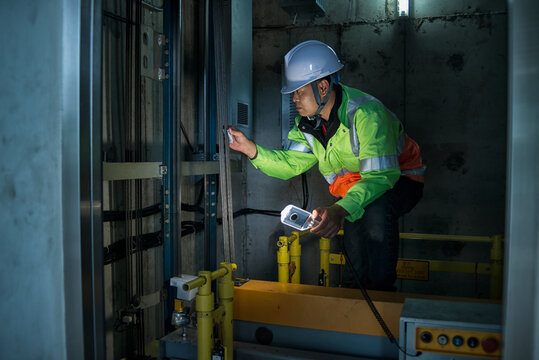
Newer towers like GTC and 88 Nairobi use IoT-monitored lifts with predictive maintenance, sensors track motor temperature, rope tension and door-cycle wear, flagging issues weeks before failure. Some use regenerative drives that feed braking energy back to the building grid, cutting lift power consumption by 20–30%.
Choosing the Right Lift for a High-Rise Building
Selecting the right lift comes down to four variables:
- Building height — buildings above 10 floors need high-speed (≥ 2.5 m/s) traction lifts.
- Traffic load — calculate peak passengers per 5 minutes; oversizing is wasteful, undersizing creates queues.
- Use case — passenger, panoramic, service, or fire-fighter lifts each follow different specifications.
- Compliance — KEBS-approved equipment and certified installation are non-negotiable.
How Much Does It Cost to Install a Lift in Kenya?
The cost of installing a lift in Kenya depends on several factors, including the building height, travel distance, passenger capacity, speed, type of lift, level of finishes, and any custom requirements.
Residential lifts for private homes are generally less complex than commercial systems, while high-rise buildings require advanced traction elevators, higher travel speeds, sophisticated control systems, and additional safety features. Options such as premium cabin finishes, destination dispatch, IoT monitoring, and energy-efficient drives can also influence the overall project cost.
Because every building has different structural requirements, a site survey is essential before preparing a quotation. Shaft dimensions, pit depth, overhead clearance, power supply, and traffic requirements all play a role in determining the final lift installation cost in Kenya.
Final Thoughts
Kenya’s skyline is rising fast. Britam Tower, GTC and 88 Nairobi have redefined what is possible in Nairobi, and projects like Pinnacle Towers will reshape it again before 2030.
Behind every successful skyscraper is something most people never see, the lift system that safely moves thousands of occupants each day. Whether you are a developer planning a high-rise, an architect specifying a lift package, or a facilities manager modernising an older tower, the right elevator partner is the difference between a building that flows and one that frustrates.
Talk to IET Solutions for expert lift supply, installation and maintenance in Kenya.
FAQs:
How many floors does the tallest building in Kenya have?
Britam Tower has 31 storeys, with 32 usable floors including the rooftop level.
What is the second tallest building in Kenya?
The GTC Office Tower in Westlands, standing 184 metres tall with 43 floors.
How fast do elevators in tall buildings move, and are they safe?
High-rise lifts in Kenya travel at 2.5–6 m/s and meet strict KEBS safety codes covering governors, buffers and fire-rated shafts.
How much does it cost to install a lift in Kenya?
A domestic lift starts around KSh 1.5M, mid-rise commercial lifts run KSh 4M–8M, and high-rise systems start from KSh 10M.